With the group presentation Flower at CHART Art Fair, shown with Nevven Gallery (Gothenburg), I present four new works alongside sculptures by Emelie Sandström and Zsófia Kresztes.
I have recently been quite curious about the connection between spiritual experiences and our biology, in particular what is happening in the brain when a person is experiencing a spiritual vision or enter a transcendental state. As we now understand through science, the brain uses a network of neurons to communicate between different parts of the brain, which again communicate with the different parts of the rest of the body. Chemical substances are released to cause certain reactions and emotions, signalled commands are sent to the different body parts causing them to move and act. It is a beautifully complex symphony of tiny little cells organising themselves to become; you.
The brain exhibits different wave frequencies, each associated with characteristic states such as deep sleep, relaxation, or heightened alertness. Brain waves are basically a measurement of the electric frequency the brain is operating at. The higher the frequency, the higher the activity level the brain is operating with. If you look at this chart of brain waves, you can see some of the states that we have observed the body to be in when the brain operates at certain frequencies. There are closer intervals between the waves, meaning it is more rapid, fast (see the zig-zag pattern in Gamma waves) while the lower frequencies show us longer intervals, making it slower. (See the smoother hills of Delta)
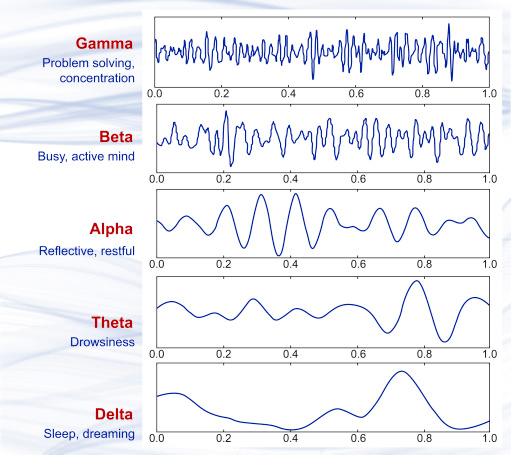
What I found interesting is the common description of spiritual experiences as transcendental. When I have felt spiritually connected, it feels as if my brain is working at a higher speed of connection and thought. It almost reminds me of a high-pitched, beautiful voice singing “Aaaaaaaah”. However, I can also be spiritually connected in a calm state, but I do not associate this with the feeling of transcending, more groundedness. One thing that I do feel regardless, is a sense of truth, which I would like to suggest might actually be a feeling of meaning, connectedness. Resonance.
So, for this exhibition, I wanted to work with the concept of characters experiencing spiritual visions, receiving deep and complex knowledge. For the research on this I have been looking at Hildegard Von Bingen, a nun and composer from Germany who lived during the middle ages. She recorded vivid visions with symbolic elements, which she interpreted through a Christian lens. Some of these were illustrated in manuscripts, often referred to as illuminations. The one that struck my mind is the first, where she describes an iron-colored mountain as well as “living sparks.” I will get into this a bit later why this in particular struck me. Here is the description of her vision:
I saw a great mountain the color of iron, and enthroned on it One of such great glory that it blinded my sight. On each side of him there extended a soft shadow, like a wing of wondrous breadth and length. Before him, at the foot of the mountain, stood an image full of eyes on all sides, in which, because of those eyes, I could discern no human form. In front of this image stood another, a child wearing a tunic of subdued color but white shoes, upon whose head such glory descended from the One enthroned upon that mountain that I could not look at its face. But from the One who sat enthroned upon that mountain many living sparks sprang forth, which flew very sweetly around the images. Also, I perceived in this mountain many little windows, in which appeared human heads, some of subdued colors and some white.
What I find interesting is that this vision is in itself not obvious to be a Christian one. It is interpreted by her to be, because this was her grounded understanding of the world. I am not saying this in disrespect to her beliefs, but I am curious about the limits of our perception and understanding. We receive information with our senses and interpret it with our reason. We cannot do anything else but compose meaning from our experiences, and this meaning is shaped by who we are.
According to science, earth was formed from dust and gas. Everything with mass exerts gravity, a force pulling matter toward a center of mass. This dust and gas gravitated and merged. Because gravitation is centered, the mass formed into a sphere. The early Earth remained molten for millions of years before cooling to form a solid crust. In science, there are different theories about how life formed, some have the evidence to be proven, some are still discussed. There is a theory that before the earth had an oxygen-rich atmosphere, its surface was exposed to intense radiation from space, which may have helped spark the formation of life. Learning about this led me to imagine that there is radiation in the form of signals sent to earth, and that recipients of these signals are caused to experience visions. So, in my two large paintings you see a character experiencing a vision, each painting is connected to a smaller work referring to the two planets these signals are coming from. One is the planet Venus, the other is the planet Jupiter.
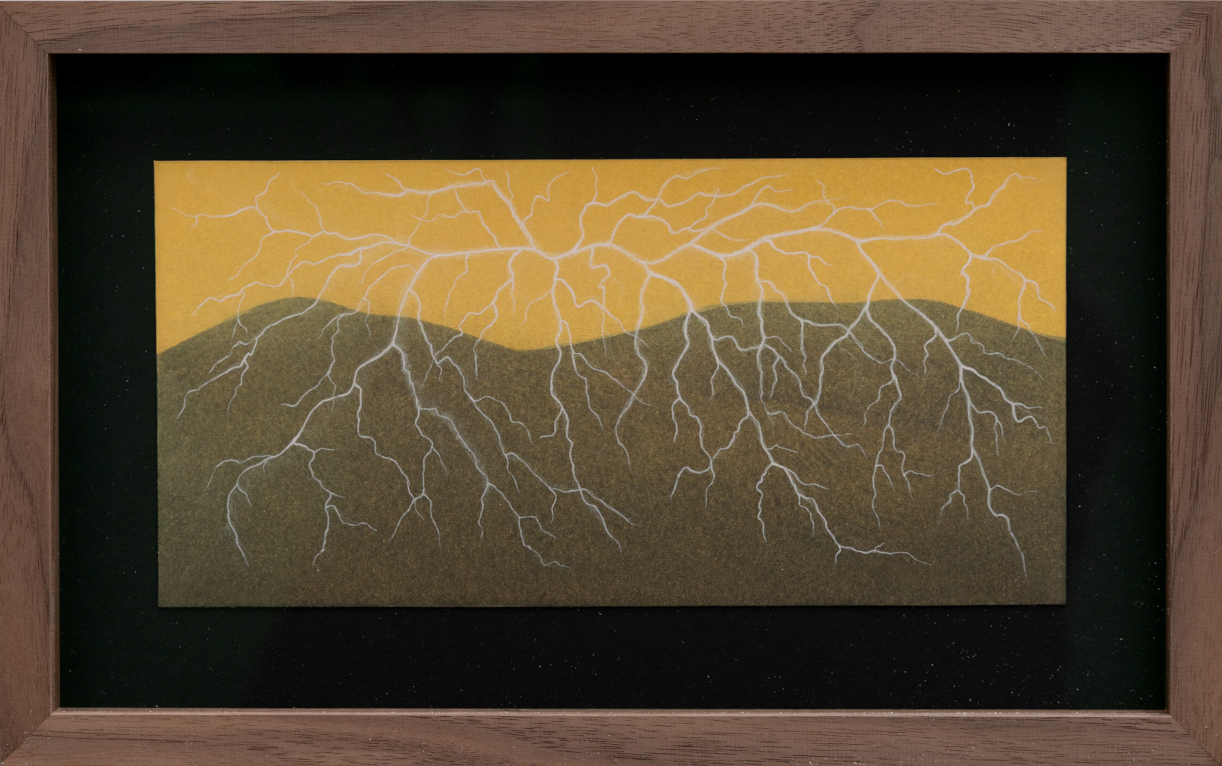
Hand of Venus (2025), watercolor on paper, picture courtesy of Nevven
Hand of Venus depicts a frozen moment of lightning across a landscape of mountains with yellow skies. The atmosphere of Venus is full of sulphuric acid, which is used to create battery acid, causing the color yellow. It is believed that lightning possibly occurs within the sulphuric clouds. Like I mentioned earlier, the brain operates on electricity, it is the transmission of these signals that combine to our thoughts. It is here that I in a sci-fictional way imagine the lightning being a form of a sentient being, but one without a body of mass. Perhaps the gas clouds are its body and the lightning are a sequence of thoughts, or perhaps it has none and merely exists for a glimpse of a second. This is where I come back to Hildegard Von Bingen, and a funny little coincidence. I read her first vision after coming up with this idea. She describes an iron-colored mountain, and ochre is the color of iron, which can range from yellow to rust-red. When buying a tube of “ochre” paint, you usually get an earthy yellow. She also describes sparks of light across the sky. You can imagine my heart raced a beat.
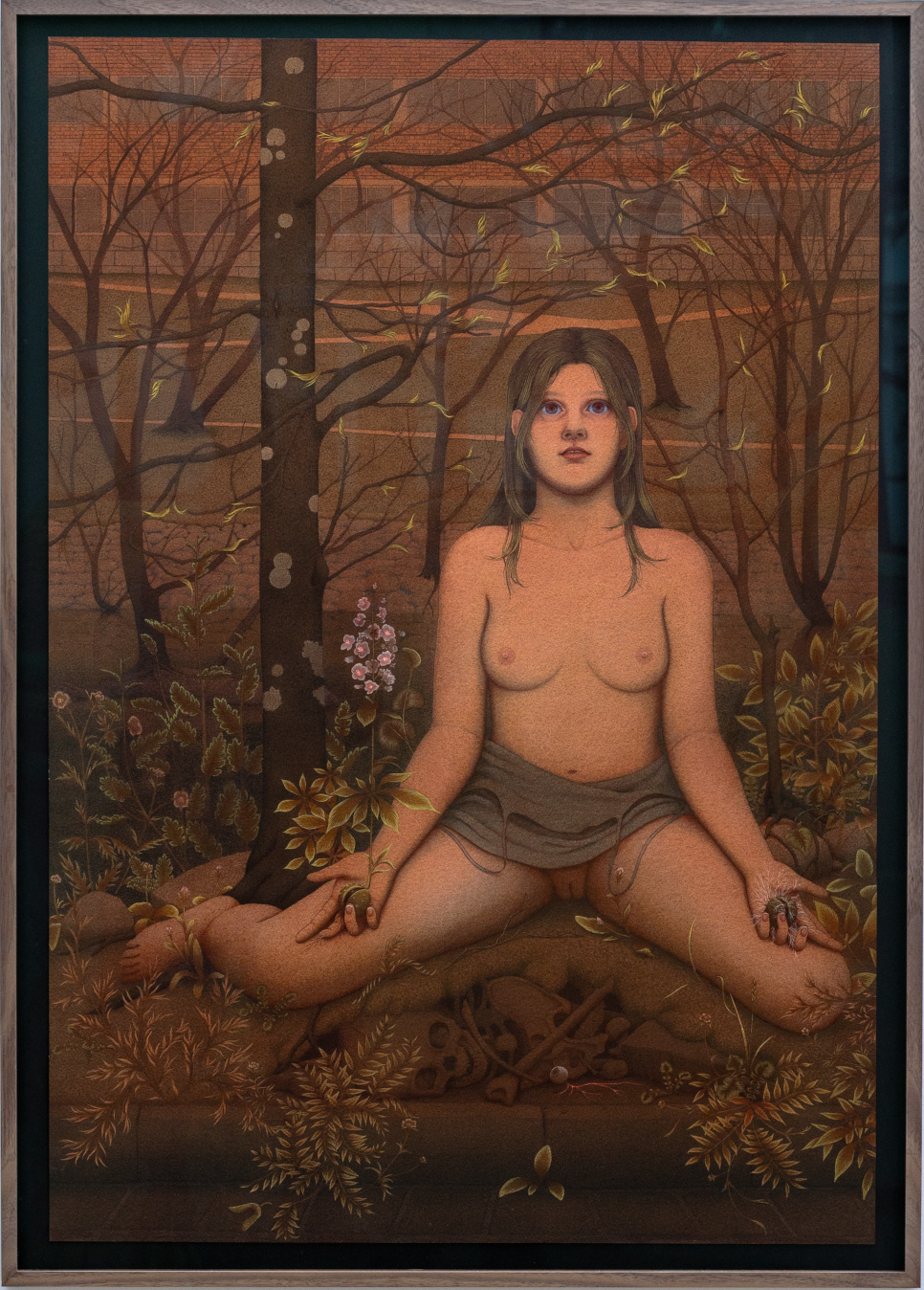
The Conduit (2025), watercolor on paper, picture courtesy of Nevven
In The Conduit we see a woman with a distant gaze, her hands resting on her thighs, each holding a chestnut. One is sprouted in full bloom, the other dead covered in a white, veiny, fungus. Life breathes in, death breathes out. The circulatory system functions with arteries carrying oxygenated blood away from the heart to the body, while veins carry deoxygenated blood back to the heart to be re-oxygenated. The title refers to her as a conduit for energy, traveling through her by touch. She receives this signal through physical sense.
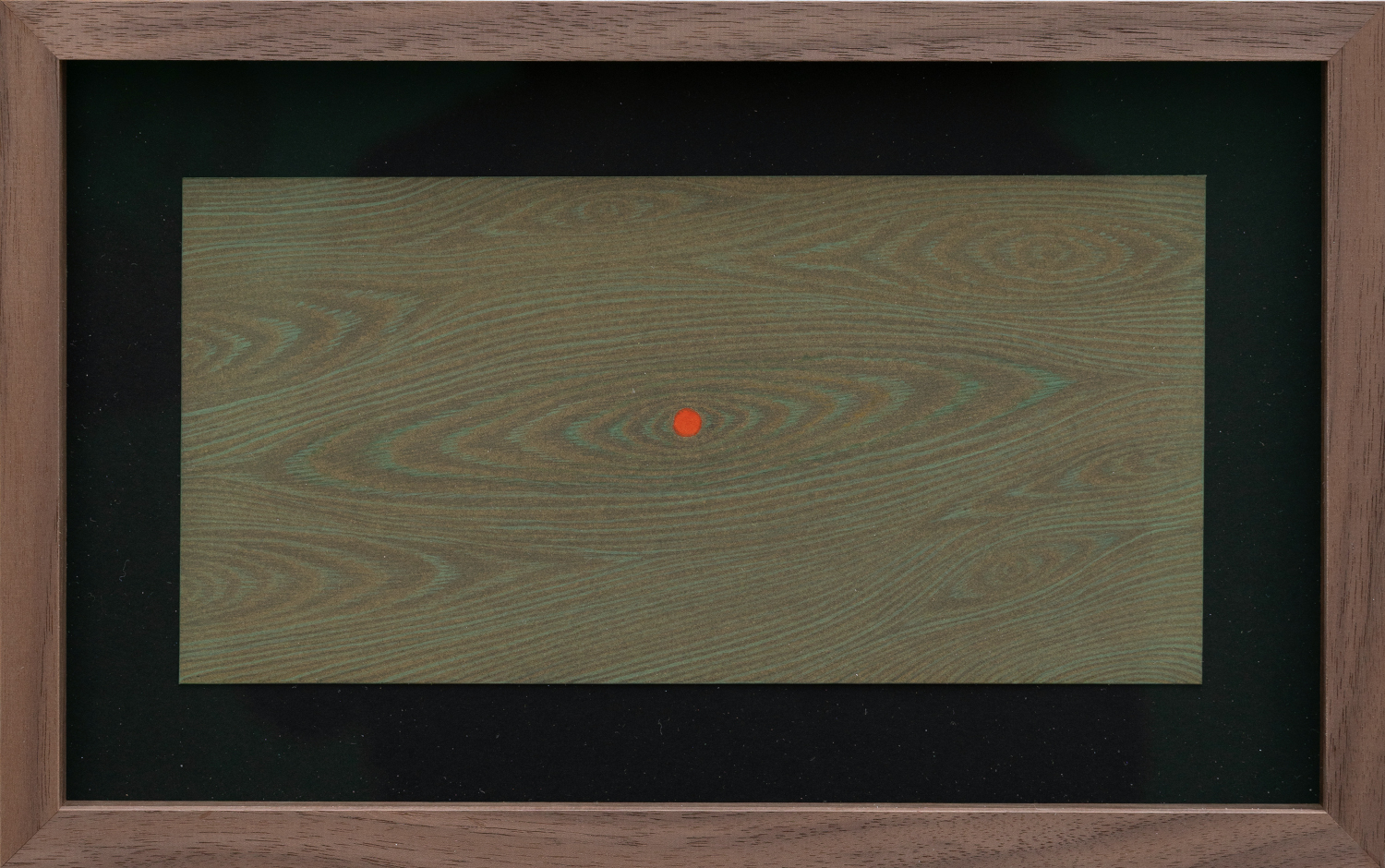
Eye of Jupiter (2025), watercolor on paper, picture courtesy of Nevven
Eye of Jupiter refers to a particular gas storm on Jupiter that forms to a red spot mimicking the look of an eye. We don’t know exactly how old it is, but it has been observed for at least 350 years. In the painting we see a small orange circle, as if light peeking through a hole, on the surface of what appears to be a greenish wood.
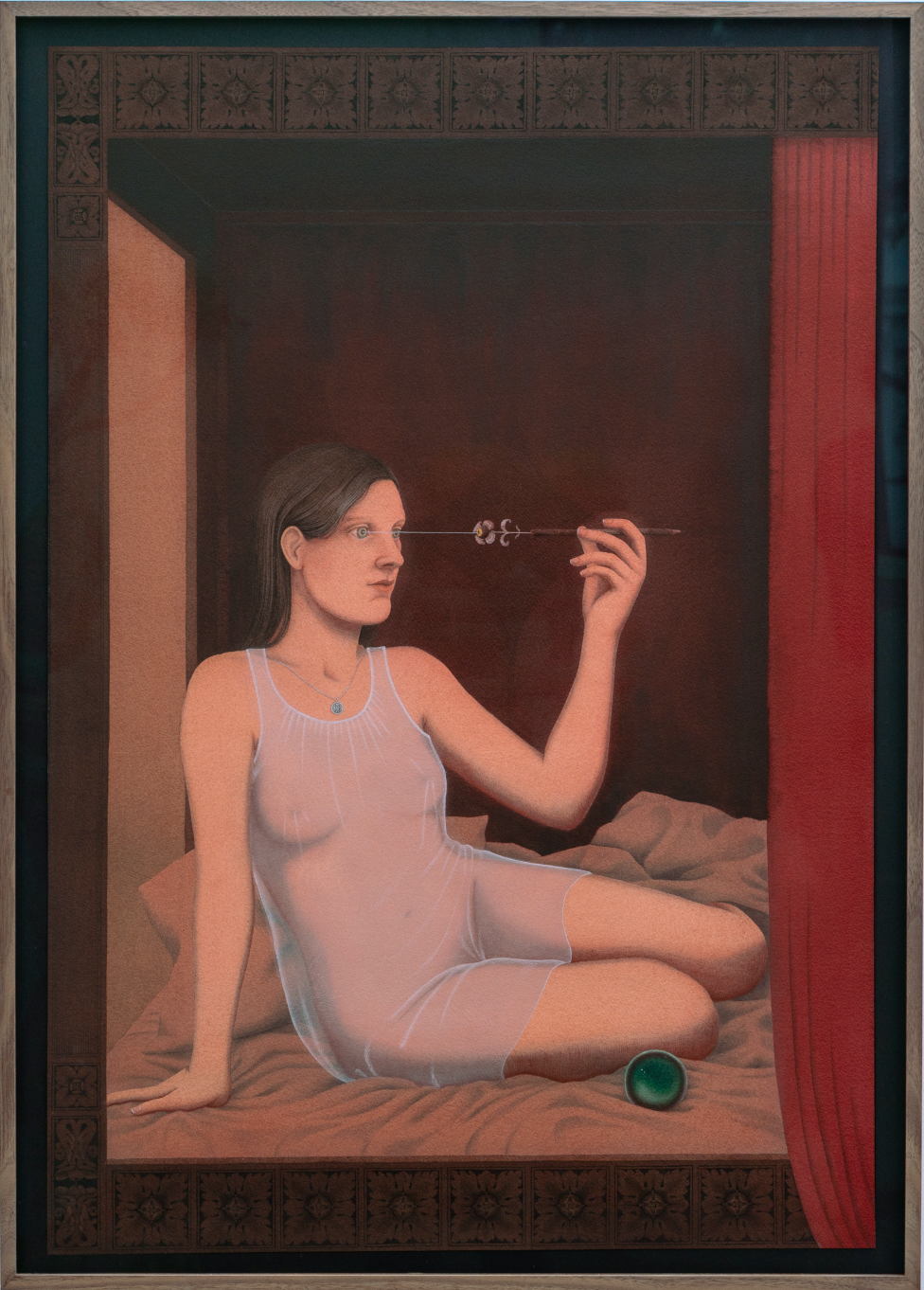
The Composer (2025), watercolor on paper, picture courtesy of Nevven
The previous work links to the painting The Composer, which depicts a woman sitting on a bed, staring into the back-end of a pencil. Out blooms a flowery eye like a wrung-out kaleidoscope, emitting a signal depicted as a white light hitting her retina. The retina is at the back of the eye, a light-sensitive tissue which receives light and transforms it to electrical signals sent to the brain. On the frame of the bed we see repeated ornaments of flowers shaped to their squared frames. I connect these shapes to the study of cymatics, a term coined in the 20th century to describe the study of how sound vibrations can be made visible. The origins of this field go back to the work of Ernst Chladni (1756–1827), a German physicist and musician. In the late 18th century, Chladni famously spread fine particles such as sand on metal plates and set them vibrating, often by drawing a violin bow along the edge. As the plate vibrates at certain frequencies, the particles gather into distinct patterns. We understand this phenomenon by categorizing the vibrating and non-vibrating areas as antinodes and nodes. The antinodes are where the plate vibrates most intensely, while the nodes are calm regions where particles settle. As the frequency increases, the distribution of nodes becomes more complex, forming intricate geometric shapes. Today these patterns are known as Chladni figures, and the plates used to demonstrate them are called Chladni plates in his honor. These patterns can range from simplistic to complex, depending on the frequency. What type of metal is used, as well as density, thickness, size and shape will have an effect on the results acquired. If you have a circular shape you get a different set of patterns than if you use a square one, while patterns from irregularly shaped plates tend to be more organic, resembling ripples on the ocean surface.
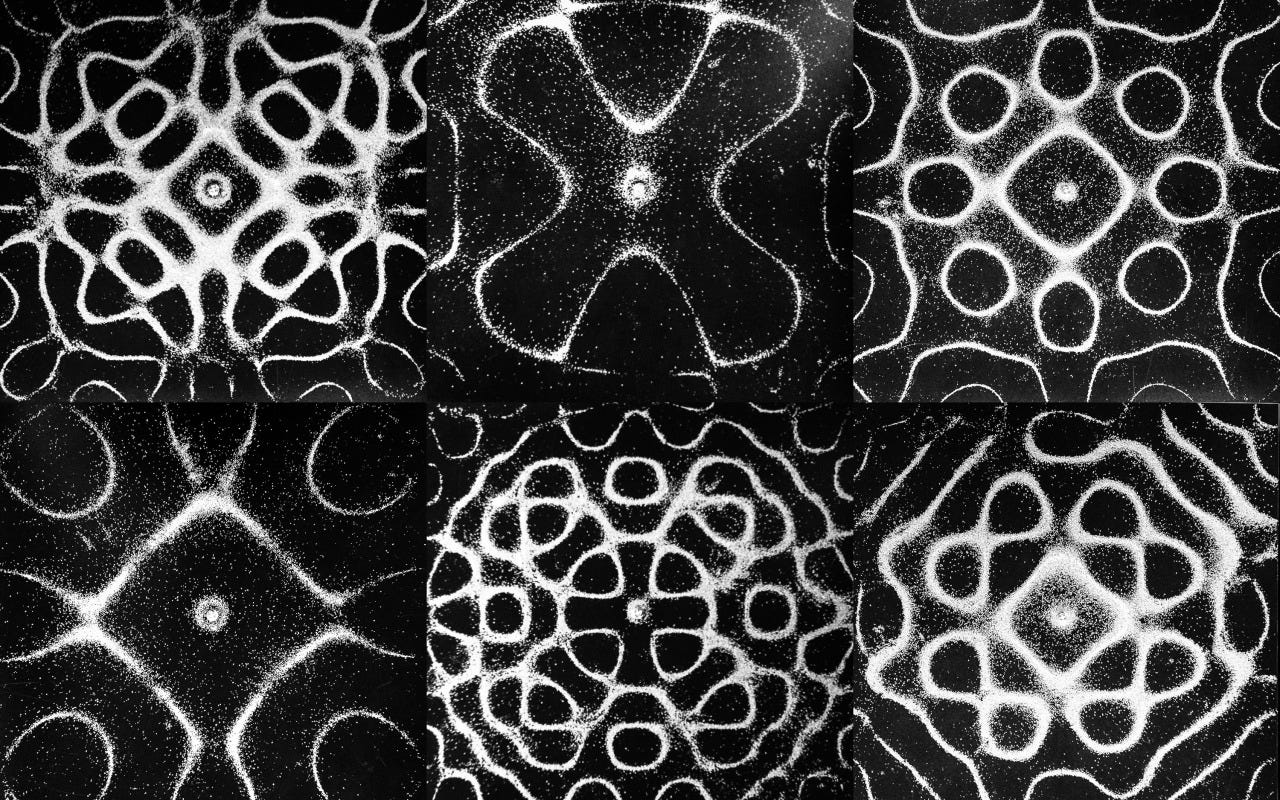
An example of patterns made with a Chladni plate.
My first personal meeting with this phenomenon physically, was when I was at an event in a venue named Boksen in Oslo. The bathroom stalls had a puddle of water in the clogged drain, shaped to a circle. The heavy bass of the music vibrated the water surface, causing this beautiful, dancing pattern.
What is so striking about these patterns is that they seem sort of recognizable while still abstract. At times they look like grids, other times a flower. One thing is certain, they are mesmerizing. Dr. Hans Jenny (1904-1972) wrote about and studied Cymatics with a theory of resonance between these patterns and structures in nature, linking it to a better understanding of the structure of the universe. I had the same feeling when I first discovered them, like there is a deeper knowledge to be understood about how things grow, how things take shape. There is something in common behind all the immense and infinite variation. If anything, it is a great illustration of how certain variables affect the result, which can be metaphorically said about humans as well. We have certain features in common, but our experiences together with our genetics, form us, which again form our perception and focus of interest. We are living Chladni plates, we are composers.
 Oda Sønderland